
Myanmar’s Military Intensifies Attacks as U.S. Reopens Diplomatic Talks
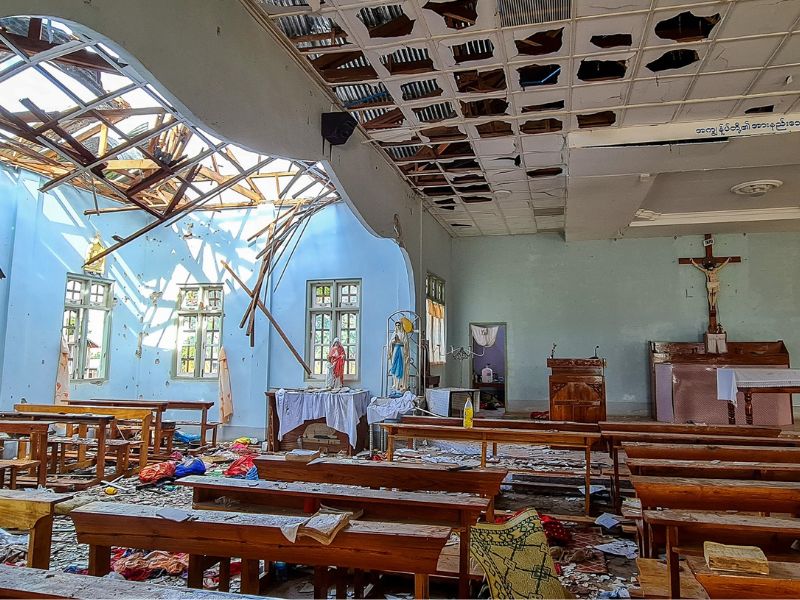
Myanmar’s military-backed government is facing renewed scrutiny over attacks on Christian communities, including the killing of pastors, the occupation of churches, and the destruction of religious sites.
The developments come even as the United States has resumed high-level diplomatic engagement with the military leadership it has largely shunned since the 2021 coup.
In September, Reverend Dal Thawn Tuang, a Baptist pastor who had served his congregation in Chin state for 22 years, was shot and killed. In October, reports emerged that military troops had burned a Kachin Baptist church and occupied other Christian religious properties in Kachin state.
Meanwhile, Washington has held two rounds of talks with Myanmar’s military government in approximately one month, raising questions about whether renewed diplomatic engagement will include meaningful demands for religious freedom and accountability for human rights abuses.
For Christians in Myanmar, these developments come amid years of armed conflict, displacement, and military repression that have severely disrupted religious life throughout the country.
Washington Reopens Dialogue with the Junta
The deteriorating conditions come as the Trump administration has begun reengaging with Myanmar’s military leadership.
According to Reuters, U.S. officials held talks with the government in Naypyitaw in September and met again in Tokyo in October. The discussions reportedly focused on securing the release of an American businessman and shutting down scam centers that defraud Americans. Access to Myanmar’s rare-earth mineral deposits has also emerged as a potential topic for broader discussion.
The U.S. Department of State said the engagement aims to deliver practical benefits for Americans, particularly those affected by transnational crime. However, the talks mark a significant shift after years of robust sanctions and limited direct engagement following the 2021 coup.
Myanmar’s military leader, Min Aung Hlaing, remains under U.S. sanctions for human rights abuses, including his role in the coup and the military’s ongoing persecution of the Rohingya.
Pastors Killed Amid Ongoing Conflict
On Sept. 14, the Burmese military reportedly shot and killed Rev. Dal Thawn Tuang, 49, assistant pastor of Lamzang Baptist Church in Chin state. According to the Burma Research Institute (BRI), Tuang was returning to his home village after conducting religious activities in neighboring Tui Tawh Village when soldiers shot him near the Kapte bridge.
An examination of his body reportedly found gunshot wounds to his chest, abdomen, and thigh. Tuang’s funeral was held on Sept. 16. He left behind his wife and two children.
Tuang’s death followed the June killing of Reverend William, a Baptist pastor, and Nam Ceu, another Christian, in the same state. The two men were arrested in May and reportedly executed by the military on June 4. According to BRI, they were accused of supporting armed opposition forces, although sources described the killings as extrajudicial.
Reverend William had served his congregation for 25 years and left behind his wife and five children. His death illustrates the dangers facing Christian leaders whose communities are caught between the military and armed resistance groups.
Churches Turned into Military Installations
In Kachin state, Christian leaders are also raising concerns about the military using churches.
On Oct. 13, International Christian Concern (ICC) reported that militias associated with Myanmar’s military had used Nant Mun Baptist Church in Mohnyin Township for military activities. The Burma Research Institute verified reports that the Shanni Nationalities Army (SNA), an armed group aligned with the military, held a graduation ceremony on the church grounds in September.
Sources familiar with the incident told BRI that militia members danced and consumed alcohol inside the sanctuary during the event. The SNA has reportedly used the church as a military training site, with six batches of recruits having trained there.
The same reporting indicated that a building belonging to St. Joseph’s Catholic Church had been used as a militia headquarters, while another building in the compound was ransacked.
The situation has also deteriorated in Bhamo, another area of Kachin State. On Oct. 12, according to Burma News International, military troops burned a church belonging to the Kachin Baptist Convention and surrounding homes as fighting against the Kachin Independence Army intensified. Local sources said troops remained in the area, preventing residents from fully assessing the damage.
A Wider Pattern of Religious Persecution
Myanmar’s military has a long record of abuses against religious and ethnic minorities. Since the February 2021 coup, attacks on Christian-majority areas have repeatedly damaged churches, displaced believers, and threatened religious leaders.
The U.S. Commission on International Religious Freedom (USCIRF) has documented continued attacks on religious communities in Myanmar, including the destruction of religious sites and the arrest and killing of religious leaders. The commission has recommended that the U.S. government redesignate Myanmar as a Country of Particular Concern (CPC), a designation reserved for governments responsible for particularly severe violations of religious freedom.
 Myanmar held the designation from 1999 through 2023, when the U.S. announced its last designations. Christian leaders have urged Washington to reissue the CPC designation, arguing that the military’s conduct warrants renewed international pressure.
Religious persecution in Myanmar extends beyond Christians. The Rohingya Muslim minority has suffered mass killings, forced displacement, and systematic discrimination. In 2017, military operations drove hundreds of thousands of Rohingya into neighboring Bangladesh, and the United States subsequently determined that the military’s actions constituted genocide.
The United Nations reported in August 2026 that human rights conditions had deteriorated further, with widespread abuses against Rohingya communities and continuing violence contributing to a humanitarian crisis. Both the military and the Arakan Army were accused of abuses against Rohingya civilians.
The United States should also consider USCIRF’s recommendation to restore Myanmar’s CPC designation and coordinate with international partners to ensure that engagement does not come at the expense of religious freedom.
For Christians in Chin and Kachin states, the consequences of the conflict are immediate and personal: pastors killed, churches burned or occupied, and families forced from their homes. As Washington reopens dialogue with Myanmar’s military-backed leadership, religious freedom must remain a central measure of progress rather than a secondary concern.
To read more news stories, visit the ICC Newsroom. For interviews, please email us. To support ICC’s work around the world, please give to our Where Most Needed Fund.