
Conditions Worsen for Stateless Rohingya Christians
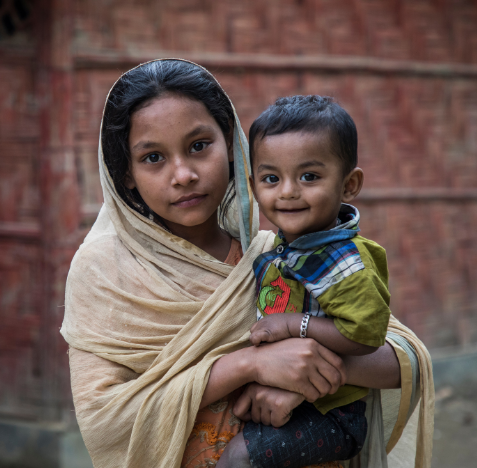
The Rohingya are known largely as a Muslim ethnic group forcibly driven from Myanmar. But a small subset of Rohingya are Christian. Numbering about 1,500 in total, these Christians comprise a small fraction of 1% of the overall Rohingya population.
Life as a Rohingya refugee is typically difficult no matter what. But the difficulty can get more intense if you are part of the Rohingya Christian minority, who face not only displacement and statelessness but also the hostility directed at apostates.
The vast majority of Rohingya come from Rakhine state on the western coast of Myanmar. But Myanmar has denied them citizenship, even though their families have inhabited the area for several generations. Authorities instead regard the Rohingya as illegal migrants from neighboring Bangladesh.
The persecution soared to a new level in 2017, when Myanmar’s military undertook “clearance operations” against the Rohingya. These endeavors led to widespread accusations of mass rapes, mass killings, and the burning of villages.
Amid such conditions, more than 740,000 Rohingya fled to Bangladesh. An estimated 550,000 Rohingya remain in Myanmar, which has seen ongoing violence since a military coup in February 2021.
A Hard Life
Sadeq Shalom, a Rohingya Christian in India who is trying to avoid deportation to Myanmar, said that only “a few” Rohingya Christians have stayed in Myanmar. Life is so tenuous for them there, as they risk facing abuse from both the nation’s military and the armed resistance groups fighting against the military.
Shalom said that most Rohingya Christians are currently in the sprawling refugee camps in southeastern Bangladesh, across the border from Myanmar.
In these camps, Rohingya Christians have faced attacks, as well as false accusations and kidnappings for marriage or forcible re-conversion to Islam.
Some Rohingya Christians facing a direct threat of violence have been staying in a transit center under police guard. But Shalom said the center “is likely to be shut down soon.”
Shalom said that current relations between Rohingya Christians and Rohingya Muslims are less difficult in India than in Bangladesh. But it was previously “very problematic,” he added. In 2014, the year he came to India, Rohingya Muslims beat a Rohingya Christian man almost to the point of death.
About 150 Rohingya Christians now live in India, which has in recent years become more proactive in enforcing regulations against both Christian and Muslim Rohingya.
In May 2025, India deported a group of 40 Rohingya — including 15 Christians, one of whom was Shalom’s brother. The Indian authorities ferried them into international waters, then distributed life jackets and abandoned them off the coast of Myanmar — the very country from which most Rohingya fled because they were facing abuses that many regard as a genocide. These deported Rohingya have since managed to make their way to another part of Southeast Asia.
In September 2026, Indian authorities served eviction notices to hundreds of Rohingya families, forcing them to dismantle the makeshift homes and shops they had built throughout the years, in some cases as long as 15 years ago. With no place else to go, these evicted Rohingya were soon sitting on the roadside.
Most Rohingya outside Myanmar have a U.N. refugee card, which, at least in theory, should provide some legal protection. But “the card is not a remedy at all,” Shalom said, adding that all the Rohingya who were detained or deported had these cards in their possession.
Shalom said the Rohingya in India these days are not hired for jobs, and their children are not able to attend school. “We have to live on the fringes of society,” he added.
Despite the bleak circumstances, Rohingya Christians have not reached out to Indian Christians.
“It is risky both for them and for us to have contact with each other,” Shalom said. “Minorities in India are already facing problems, and if somehow they are found to be in contact with us, they could suffer even worse consequences.”
Searching for Home
Shalom said he and his fellow believers would like to leave India at this point. But, to say the least, it’s unclear where they can go. After all, they are unwelcome in any country and, as apostates, they are excluded and, at times, victimized by non-Christian Rohingya.
Whether in Bangladesh, India, Myanmar, or elsewhere, “None of us is safe at all,” Shalom said. “There is the same fear … the same mental trauma.”
He knows of no Rohingya Christian who holds citizenship in any country. With no nation obligated or inclined to help, they hope a Christian or humanitarian organization will secure a place to live and work with some level of legal protection.
They may not have a country, but they still feel they will find a home somewhere. As Shalom said, “We are living with the hope that we will one day make it.”
Story by R. Cavanaugh
To read more news stories, visit the ICC Newsroom. For interviews, please email us. To support ICC’s work around the world, please give to our Where Most Needed Fund.