
The Disappearing Christian Middle East, Part V: The Holy Land — When Christians Leave the Birthplace of Christianity
Every December, Elias watches pilgrims pour into Bethlehem.
From the doorway of his family’s small olivewood shop, he hears church bells ringing above the old stone buildings. He watches visitors walk toward the Church of the Nativity. Some have traveled thousands of miles for the chance to stand in the city where Christians believe Jesus was born.
For Elias, however, Bethlehem is not a pilgrimage destination. It is home. His grandfather carved crosses and nativity scenes from olivewood, and his father expanded the business and began selling religious gifts to tour groups.
Elias grew up sweeping sawdust from the shop floor, learning English phrases from tourists, and attending church with his family on Sundays. His grandparents are buried nearby; his children were baptized there. Nearly every street carries a memory.
Lately, however, Elias and his wife, Rania, have begun discussing something neither imagined when they married: leaving.
Their oldest daughter has been accepted to a university overseas, their son talks about finding work in Europe, and tourism has collapsed again because of war and instability. Some months, the shop barely covers its expenses.
Rania’s sister in Canada calls regularly, reminding them that jobs and opportunities exist there for the children. Elias usually changes the subject.
Then one night, after the children had gone to bed, he and Rania sat at the kitchen table. She asked him a question he couldn’t easily answer: “What happens if the children leave? Do we stay here alone because our grandparents stayed?”
From their window, they can see the outline of a church in the distance. The building will probably still be there decades from now. What Elias no longer knows is whether his family will be.
For Christian families like this one, that question lies at the center of one of the most troubling transformations taking place in Christianity’s birthplace.
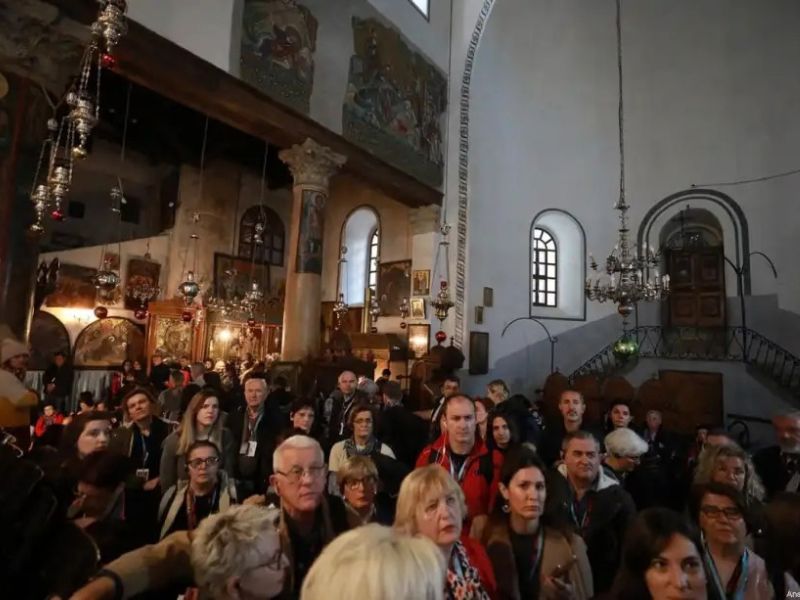
At Christmas, the Christian world turns its eyes toward Bethlehem. Pilgrims walk through Manger Square, church bells ring above the narrow streets, and worshippers enter the Church of the Nativity, traditionally revered as the place where Jesus was born.
Television cameras carry those images into Christian homes around the world, and for a few days it can appear that Christianity is flourishing in the city where its story began. But step away from the pilgrimage sites and another story emerges. The churches remain, but the people are becoming fewer.
International Christian Concern (ICC) reported in 2025 that Christians once represented roughly 85% of Bethlehem’s population. Today, they make up only a small fraction of the city’s residents.
The contradiction is difficult to ignore. Millions of Christians worldwide dream of visiting Bethlehem. Few places on earth are more closely associated with Christianity than the Holy Land.
Bethlehem, Jerusalem, Nazareth, the Sea of Galilee, and the Mount of Olives are names spoken in churches worldwide every week. Yet, Christians living in these places now make up only a small percentage of the region’s population.
Palestinian Christian communities trace their roots in the land through centuries of Christian history and include Greek Orthodox, Roman Catholic, Armenian, Syriac, Lutheran, Anglican, evangelical, and other traditions.
Their presence extends far beyond churches. Christians have established schools, hospitals, universities, businesses, charities, and cultural institutions throughout the region. Generations of Christian families have worked as teachers, physicians, shopkeepers, craftsmen, clergy, business owners, and community leaders.
Yet their numbers have steadily declined. In its examination of Bethlehem’s shrinking Christian community, ICC reported that Christians represented about 84% of Bethlehem’s population in 1947. By 2016, that figure had fallen to around 12%, while Christians represented less than 2% of the West Bank population.
For Christians living in the Holy Land, a Christian family may live relatively close to one of the faith’s holiest sites and still struggle to reach it. Travel between Gaza, the West Bank, Jerusalem, and Israel is heavily regulated. Permits, checkpoints, security restrictions, and closures can affect whether Palestinian Christians can attend religious celebrations, visit relatives, work, or travel to churches.
In 2019, ICC reported that Christians in Gaza faced uncertainty over whether permits would be issued allowing them to travel to Bethlehem for Christmas. Israeli authorities initially said they would not grant permits. They later approved some applications, citing security considerations.
The irony is difficult to miss: A Christian living thousands of miles away finds it easier to visit Bethlehem than a Christian living relatively nearby.
Movement restrictions are not the only reason Christians leave, but they become part of a larger accumulation of pressure. Political conflict, economic hardship, insecurity, religious tensions, and restrictions on everyday life can eventually turn the question from “How do we stay?” into something very different: “Why stay?”
For Gaza’s already tiny Christian population, that question became far more urgent after Oct. 7, 2023. Hamas’s attack on Israel triggered a devastating war in Gaza, affecting the territory’s entire civilian population, and Christians were no exception.
Before the war, Gaza was home to only around 1,000 Christians, most belonging to the Greek Orthodox community with a smaller Catholic population. As fighting intensified, churches became places of refuge.
Families crowded into church compounds, which might offer some protection from the violence outside. Among those shelters was Saint Porphyrius Greek Orthodox Church, which has served Gaza’s Christian community for centuries.
That month, an explosion struck a building within the church compound where civilians were sheltering, killing people inside. ICC later documented the suffering of Gaza’s Christian community, describing Christians seeking refuge at Saint Porphyrius and Holy Family Catholic Church as the war unfolded around them.
These Christians faced the same bombardment, shortages, displacement, fear, and uncertainty affecting Gaza’s broader civilian population. But a community this small faces an additional problem: Every person matters demographically. A city containing millions of people may eventually recover substantial population losses after war. A religious community numbering only about 1,000 may not.
The stories examined throughout this series are different, but the pattern is becoming familiar. The Islamic State group (ISIS) drove Christians from Iraq’s Nineveh Plains. War scattered Syria’s Christian communities. Economic collapse and political instability have pushed Lebanese Christians abroad. In Bethlehem, Jerusalem, the West Bank, and Gaza, conflict, insecurity, restrictions, economic hardship, and emigration continue to shrink ancient Christian populations.
Different causes are producing a remarkably similar result: fewer Christians.
Part six will move to places where this process has already advanced much further. These are lands where Christianity was once not merely present, but dominant — places where today only small Christian remnants remain.
Their history offers perhaps the strongest warning of this entire series: A civilization does not always disappear because every monument is destroyed. Sometimes the churches survive, the crosses remain, and the history remains, but the Christians are gone.
To read more news stories, visit the ICC Newsroom. For interviews, please email us. To support ICC’s work around the world, please give to our Where Most Needed Fund.