
The Disappearing Christian Middle East, Part III: Syria — War, Displacement, and a Vanishing Christian Community

By ICC Fellow Lisa Navarrette
On Sunday, June 22, 2025, Christians gathered for worship inside Mar Elias Greek Orthodox Church in Damascus. Families sat together, prayers were spoken, and the familiar rhythms of worship continued in a city with a healthy Christian population for nearly two thousand years.
Then a man entered the church carrying explosives.
According to International Christian Concern, the attacker opened fire before detonating an explosive vest inside the sanctuary. At least 22 worshippers were killed and dozens more were wounded. The attack came amid continuing concern about Islamic State group activity and the vulnerability of Syria’s religious minorities.
The bombing was horrifying, but for Syria’s Christians, it was also familiar in another sense. For more than a decade, nearly every new attack has carried the same underlying question: Is there still a future for us here? Civil war, Islamic extremism, economic collapse, displacement, and repeated political upheaval have each taken something from Syria’s Christian population.
Syria occupies an extraordinary place in Christian history. Damascus appears prominently in the New Testament, most famously in the account of the Apostle Paul’s conversion on the road to the city.
Antioch, the historical Syrian region now part of modern Turkey, became one of Christianity’s earliest and most influential centers. Across Syria, ancient Christian towns and villages survived for centuries.
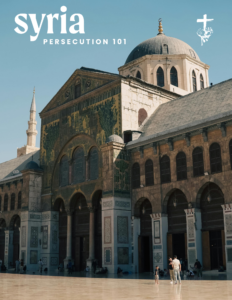 In Maaloula, residents preserved forms of Aramaic, the language closely associated with Jesus. In Aleppo and Damascus, Armenian, Syriac, Greek Orthodox, Melkite Catholic, Maronite, Evangelical, and other Christian communities became deeply woven into the social fabric of the cities.
Before Syria’s civil war began in 2011, Christians numbered about 1.5 million, according to ICC’s reporting on the country’s postwar transition. Then the country fractured. Protests that began in 2011 grew into a devastating civil war involving the Syrian government, opposition groups, Kurdish forces, Islamist factions, ISIS, and numerous foreign powers. Entire cities became battlefields and millions of Syrians fled. Many never returned.
Few cities demonstrate Syria’s Christian decline as clearly as Aleppo. For generations, Aleppo contained one of the country’s largest Christian populations.
Churches, schools, businesses, and neighborhoods reflected centuries of Christian presence. Then the war arrived. By December 2023, ICC estimated that roughly 200,000 Christians had left Aleppo since the beginning of the conflict.
Far to the northeast, another Christian community tells an even more dramatic story. For decades, Christian villages lined the Khabur River. Then ISIS came.
In 2015, militants attacked Assyrian villages, kidnapped Christians, and drove families from their homes. Years later, the population had barely recovered. ICC reported that the Christian population of Syria’s Khabur Valley had fallen from about 15,000 people to only a few hundred.
ISIS Was Only Part of the Story
It would be easy to explain Syria’s Christian exodus entirely through Islamic extremism, but that would be incomplete.
ISIS and other extremist organizations inflicted extraordinary suffering on Christian communities. Christians faced kidnapping, execution, church destruction, displacement, and threats directed at their religious identity.
Yet the war itself also created conditions that made ordinary life increasingly difficult. Electricity became unreliable. Infrastructure deteriorated. Jobs disappeared. Food prices increased. Housing was destroyed. Young people saw few opportunities, and families were separated across borders.
ICC has repeatedly documented that economic deterioration became one of the forces pushing Christians out. It reported in 2023 that roughly 80% of Syria’s Christians were believed to have left during the previous two decades, leaving an estimated Christian population of around 200,000 people.
Estimates vary because war and mass displacement have made reliable demographic measurements extremely difficult. But the direction of the numbers is unmistakable: Syria is losing Christians.
There is an important difference between leaving because someone threatens to kill you and leaving because everyday life has become impossible, but for Christian communities the two can become closely connected.
A family may initially flee its town because of ISIS and move to Damascus. Then the father cannot find work, the children struggle to continue school, and relatives who have already emigrated encourage the family to join them abroad.
Eventually, the family leaves Syria permanently. What began with persecution ends with emigration.
Assad’s Fall
In December 2024, Syria changed again. After more than two decades in power, Bashar al-Assad’s government collapsed following a rapid rebel offensive.
Assad fled the country, and Hay’at Tahrir al-Sham (HTS) emerged as the dominant force behind Syria’s new political order.
For many Syrians, Assad’s fall represented the end of a brutal authoritarian system. For Christians, however, it also introduced another period of uncertainty.
HTS had roots in the Islamist militant movement and had previously been associated with al-Qaida’s Syrian branch. Its leadership attempted to reassure religious minorities as it took power.
As rebel forces entered Aleppo, ICC reported that Ahmed al-Sharaa, then widely known as Abu Mohammad al-Jolani, emphasized religious diversity and instructed fighters to protect minorities.

Early reports from Christian neighborhoods included assurances that churches and Christmas celebrations would be respected. But Christians had lived through too many sudden changes of power to rely on promises alone. They watched carefully to see what the new Syria would become.
Only weeks after Assad’s fall, masked men burned a Christmas tree in the Christian-majority town of Al-Suqaylabiyah. Christians took to the streets.
ICC reported that hundreds protested and demanded protection for Christian religious practices and symbols. Syrian Christians were not simply asking whether they would be allowed to survive. They were asking whether they would be allowed to remain publicly Christian. That question became even more urgent after the attack on Mar Elias Church six months later.
The June 2025 bombing in Damascus was among the deadliest attacks on Syrian Christians in years. People had gone to church to pray. Some left in ambulances; others never left alive. The news reported the attack as part of an environment of violence and instability confronting minorities during Syria’s political transition. The future for Syrian Christians remained uncertain. That uncertainty has demographic consequences.
The Future of Syria
Christianity has not disappeared from Syria. In Damascus, Aleppo, Maaloula, and elsewhere, Christians still gather for worship. Priests celebrate Mass. Pastors preach. Churches provide food and assistance to struggling families. Parents baptize children. Christmas is still celebrated.
In northeastern Syria, tiny communities continue living in villages that once held thousands. Their presence carries extraordinary historical weight. These Christians are not preserving a museum exhibit. They are preserving a living civilization.
That distinction matters because the goal cannot simply be to preserve ancient churches after their congregations disappear. The survival of Christianity in Syria depends on Christians being able to remain in their homeland with security, dignity, economic opportunity, and genuine religious freedom.
ICC works directly with vulnerable Christians in Syria as they face displacement, economic hardship, and insecurity. ICC has supported families by providing medical aid and necessities, helping create income opportunities, assisting churches as they care for traumatized communities, and supporting Christians rebuilding in places such as Aleppo and Homs.
Part four of this series turns to Lebanon, a country long considered the strongest remaining center of Christian political and cultural influence in the Arab Middle East. Unlike Iraq and Syria, where war and extremist violence drove dramatic waves of Christian displacement, Lebanon’s Christian decline has unfolded through a more complicated combination. This includes civil war, political instability, economic collapse, emigration, and demographic change.
Christians remain deeply woven into the country’s identity. However, the same question now follows Lebanon, which has followed this series from Iraq to Syria: How long can an ancient Christian presence remain strong when so many of its people continue to leave? Part two of this series can be found here.