
One Year After Assad, Continued Uncertainty for Persecuted Minorities in Syria
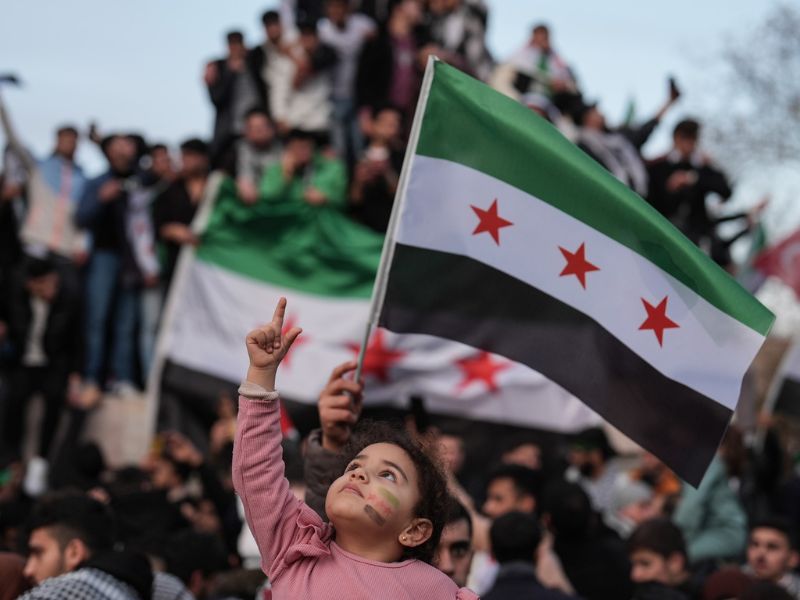
Celebrating one year since the toppling of longtime dictator Bashar al-Assad, Syrians this week are taking to the streets of Damascus in scenes of mass joy accompanied by fireworks, festive music, and the new national flag.
But while the large crowds of jubilant celebrants are an illuminating glimpse into the brutality of the Assad regime and how it impacted everyday Syrians, the reality is still grim today for many Syrians living in post-Assad Syria under the leadership of President Ahmed al-Sharaa.
Despite lip service to the importance of inclusion, democracy, and individual freedoms, progress on those fronts has been slow and halting during the last 12 months.
Ethnoreligious minorities have been particularly targeted in recent months, with large-scale massacres killing hundreds of Druzes and Alawites in cities with large minority populations, such as Homs.
In other areas, Christians have faced a deadly wave of violence throughout 2025. The most harrowing example came on June 22, when a suicide bomber attacked Mar Elias Church in Damascus: after opening fire on congregants during Divine Liturgy, he detonated an explosive vest inside the church, killing at least 22 worshippers and injuring dozens more.
This massacre — the first major church bombing in Syria since the fall of Bashar al-Assad last December — sent shockwaves through Syria’s Christian community, renewing fears that places of worship are no longer safe even under the new government.
According to a report published by the Syriac Strategic Research Center (SSRC) in late 2025, this attack is not an isolated incident. The report documents a disturbing pattern: dozens of smaller-scale but still violent events — including vandalism of churches, desecration of cemeteries, forced displacement of Christian families, and threats/intimidation — across multiple regions like Hama, Homs, Tartus, Latakia, and Suwayda.
Churches have had crosses knocked down, icons destroyed, and Christian cemeteries violated. As a result of rising insecurity, many Christian families report feeling insecure.
Although the new administration under Ahmed al-Sharaa has pledged to protect minorities and restore a sense of normalcy, these incidents — especially the church bombing — lay bare the fragility of those guarantees. In the face of such violence, for many Syrian Christians, the hope of a stable post-Assad era has become overshadowed by fear, grief, and uncertainty about whether they will ever truly be safe.
Al-Sharaa is moving toward a system that grants the central government significant authority, rather than a federated system in which local areas retain robust self-determination and the right to organize their own security.
The country’s recent election did not solicit votes directly from the public; instead, it turned to local councils chosen by regional electoral bodies. A direct public vote was deemed logistically impossible at the current time, with many citizens displaced and without proper identification after decades of civil war.
One hundred and nineteen new parliamentarians were announced after voting in October. An additional 21 seats were not voted on because they represent areas not currently under government control, and the remaining seventy seats in the 210-member parliament will be appointed directly by al-Sharaa.
Only six seats went to women, and fewer than a dozen went to members of religious and ethnic minority communities. The overwhelming majority of those elected belong to the dominant Sunni majority, leading to concerns that the new parliament may usher in an era marked by Sunni nationalism.
Only a single Christian was elected, according to media reports. While Christians are largely concentrated in cities such as Damascus and Aleppo, these areas did not choose a Christian representative.
Observers both within the country and internationally are eagerly awaiting President al-Sharaa’s 70 parliamentary appointments, originally scheduled to be announced in mid- to late October. However, the original deadline has passed without any appointments.
Immediately after the election, Syrian government officials indicated that his appointments would seek to address some of the imbalances in the election results. Whether the appointments make good on that promise or double down on the Sunni majority already in place remains to be seen.
To read more news stories, visit the ICC Newsroom. For interviews, please email [email protected]. To support ICC’s work around the world, please give to our Where Most Needed Fund.