
Nigeria Remains in the Crosshairs of Attention for Crimes Against Christians
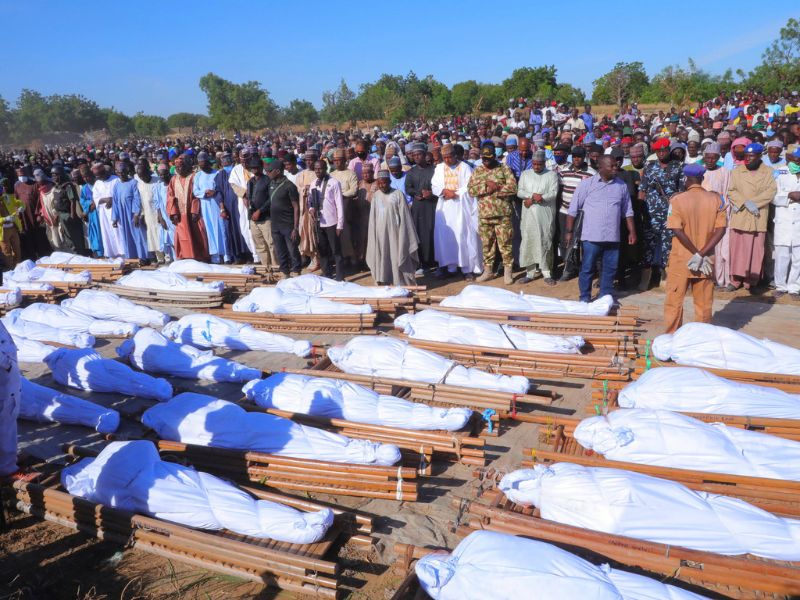
Nigerian government leaders remain in a global vise of attention and pressure for the ongoing mass killings and kidnappings of Christians by Islamic extremists.
The U.S. Department of State this week opened the door for travel sanctions against Nigeria’s leaders who violate religious freedom.
“The United States is taking decisive action in response to the mass killings and violence against Christians by radical Islamic terrorists, Fulani ethnic militias, and other violent actors in Nigeria and beyond,” the State Department said in a press release. “A new policy under Section 212(a)(3)(C) of the Immigration and Nationality Act will allow the State Department to restrict visa issuance to individuals who have directed, authorized, significantly supported, participated in, or carried out violations of religious freedom and, where appropriate, their immediate family members. The policy applies to Nigeria and other governments that violate religious freedom.
“As President Trump made clear, the ‘United States cannot stand by while such atrocities are happening in Nigeria, and numerous other countries.’”
With the longstanding atrocities against Christians finally making mainstream waves, Nigerian President Bola Tinubu named former top general Christopher Nusa to replace Defense Minister Mohammed Badaru Abubakar, who resigned this week. Abubakar cited health concerns amid ongoing attacks against Christians and the mass kidnapping of more than 300 schoolchildren.
A tsunami of frustration over the ongoing killing of Christians in Nigeria, a storm that has brewed and created carnage for decades, has riled the Trump administration and world leaders. Nigerian officials have defended themselves, saying the violence affects all faiths and has myriad issues, from climate change to resource competition to marauding bandits.
Global attention surged after U.S. President Donald Trump described the mass killings of Christians as “genocide,” and the State Department’s recent designation of Nigeria as a Country of Particular Concern (CPC). Nigeria had previously been named a CPC in 2020, yet the new framing of the crisis as “genocide” triggered a stronger global reaction. This decision was bolstered by U.S. Sen. Ted Cruz’s (R-FL) Nigeria Religious Freedom Accountability Act of 2025.
International Christian Concern (ICC) has long chronicled the persecution of Nigeria’s Christian community, which has killed an estimated more than 50,000 believers during the past decade and displaced tens of thousands. In-country ICC staff regularly report on attacks, and Nigeria was included in ICC’s 2024 Global Persecution Index.
ICC has many significant aid projects in Nigeria, including communal farms, Hope House schools, emergency relief programs, one-time aid projects, and much more. ICC has advocated for Nigerian believers on Capitol Hill, and ICC President Shawn Wright recently issued a “Call to Action” to U.S. and Nigerian officials.
With the increased attention on Nigeria, from global leaders to entertainers like rapper Nicki Minaj, ICC’s Africa team responded to several important questions: What do Nigerians make of this recent global attention, and what difference is it making for believers? Are there measurable changes now or in the future?
ICC staff members said that major global powers — China, Russia, and the U.S. — have shown interest, revealing the strategic importance of Nigeria. China’s government’s support for Nigeria, despite Trump’s recent statements, after years of silence, and Russia’s recent backing, suggests that powerful countries have economic and geopolitical interests in Nigeria.
With these three U.N. Security Council members involved, broad measures to invoke international intervention, such as the Responsibility to Protect doctrine that requires states to shield their populations from genocide and crimes against humanity, will likely be blocked.
The heightened attention has also increased religious tensions, ICC staffers said. While Christians welcome the recognition of their suffering, many Muslim groups deny a Christian genocide, claiming instead that Muslims are the primary victims. Conferences in Abuja and statements by the African Union reflect efforts to counter the Christian genocide narrative.
Overall, the situation in Nigeria is deeply complex, driven by a mix of jihadist violence, criminality, political interests, and weak national institutions. Government policies appear to favor rehabilitating militants rather than protecting victims, leaving displaced Christians vulnerable, ICC staff members said.
The global attention, however, has brought significant hope to many Nigerian believers.
“There is great relief that at the very least, the plight of Christians now features on international media and has attracted global attention,” an ICC staffer said. “As the long-expected help or ‘deliverance’ continues to delay, however, many are becoming despondent as the direct implication of this global attention has served to worsen the situation on the ground.”
More daring and audacious attacks have resumed; mass school kidnappings are ongoing to the point that schools in many states have been shut down. Travelers are no longer safe as they are captured and murdered in the most gruesome manner.
Just recently, worshippers in Eruku, Kwara state, were abducted while some were killed during a worship service. A top army general was executed by terrorists who not only boasted about their exploits but also threatened to abduct President Tinubu.
“Many more atrocities continue as some do not make it to the media,” one ICC staffer said.
Members of ICC’s Africa team noted possible measurable differences now and in the future:
- Current, evidence-based reports of the attacks and situations with stories and testimonies to help legislators and other public figures willing to amplify the situation. This will create pushback on denials and make governments more accountable. This can start at small, local levels to make the impact easier to measure.
- Bolder protective measures for Christian survivors — emergency response trainings, awareness, and preparedness for the most vulnerable Christians, and intelligence gathering networks. This can help reduce the number of attacks. If started in specific towns and communities, the impact can be measured and scaled up.
- Increased transformation interventions like trauma counselling, skills acquisition, and a broader support network. This will help Christians to be resilient in the face of persecution and keep the faith.
- Lobbying of Christian leaders and support to enable them to speak up and make the government accountable. If started in communities, and the government begins to respond and become accountable, it can be scaled up, and partnerships will spring up in this regard.
- Protection of defenders and courageous leaders and organizations who continue to amplify the situation. This can be measured by the level of advocacy and sustained interest in alleviating the situation locally and internationally.
To read more news stories, visit the ICC Newsroom. For interviews, please email [email protected]. To support ICC’s work around the world, please give to our Where Most Needed Fund.