Vietnam Demolishes Historic Catholic Property Amid Church Land Dispute
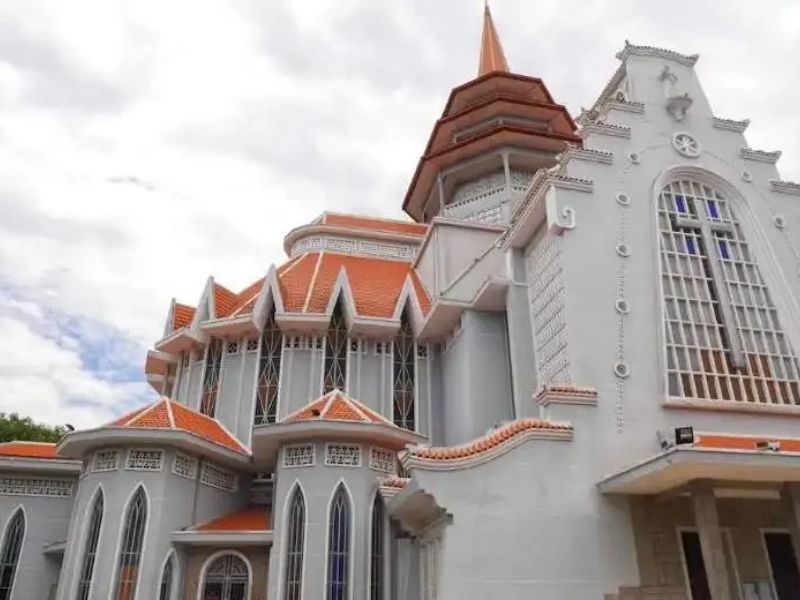
Vietnamese authorities demolished a historic building belonging to the Redemptorist Catholic community in the central city of Huế on Tuesday, escalating a decades-long dispute over church property and raising renewed concerns about religious freedom in the communist-governed country.
The demolition of the L’Accueil building followed the deployment of police by local authorities to block roads surrounding the Redemptorist monastery and Our Lady of Perpetual Help Church. Electricity to the area was also cut, preventing some parishioners from reaching the church to attend Mass or express solidarity with the religious community.
According to the Redemptorists, heavy machinery began demolishing the structure while priests, religious brothers, and parishioners gathered nearby in prayer. The demolition continued through Nov. 18, leaving the property leveled and fenced off.
The Redemptorist Provincial Chapter of Vietnam condemned the operation, arguing that authorities proceeded despite unresolved legal questions and repeated requests to review the property’s ownership.
“Justice cannot be established through force, and the truth cannot be erased along with the structures that have been demolished,” the congregation said in a Nov. 17 statement as the demolition was proceeding.
Communist Land Takeover
The dispute centers on land that the Redemptorists purchased in 1930. According to historical documentation cited by the religious order, Huế municipal authorities formally recognized the congregation’s ownership in 1971.
The L’Accueil complex was subsequently developed on the property between 1938 and 1943. It served as a center for educational, cultural, and community activities, housing a library, auditorium, and reading room. A sawmill was also established on the grounds in the 1950s, providing local employment.
Following the communist takeover of South Vietnam in 1975, the government’s relationship with religious institutions changed significantly. Church properties throughout the country came under increasing state control, with religious communities frequently losing access to land and buildings they had previously owned.
The Redemptorists maintain that they never voluntarily surrendered their rights to the L’Accueil property. They acknowledge that the congregation transferred assets associated with a sawmill to the state in 1978, but argue that the transfer did not include the land itself.
Authorities subsequently assigned the property to government-controlled institutions. The remaining parcel, measuring about 2,550 square meters, is currently managed by a local sports vocational school.
Recent Efforts
The congregation has sought the property’s return since 1994. Its most recent formal complaint, submitted to the Huế People’s Committee on Oct. 24, requested recognition of its land-use rights and clarification of the property’s legal status.
Authorities reportedly rejected the complaint in a Nov. 8 response, stating that it had no basis for consideration.
A notice posted at the property in October announced plans to develop a public park and parking lot on the site. Local authorities have defended the project as serving public interests, including improving traffic conditions and providing additional green space in a densely populated area.
Vietnamese law establishes that land is collectively owned by the people and administered by the state. Government authorities have also invoked a 2003 National Assembly resolution that generally prevents reconsideration of certain land and housing arrangements established before July 1, 1991.
The Redemptorists, however, dispute the government’s interpretation of the property’s history and say authorities have not adequately explained the legal grounds for demolishing the building. They have asked officials to publicly disclose the documentation supporting their decision and review the historical records presented by the congregation.
The dispute illustrates the difficulties religious communities in Vietnam face when attempting to recover properties taken under the country’s postwar land policies. Although the government permits registered religious organizations to operate, state control over land and religious activities can leave even established religious institutions with limited avenues to challenge government decisions.
Deteriorating Religious Freedom in Vietnam
The demolition also comes amid continuing international scrutiny of Vietnam’s religious freedom record.
The U.S. Commission on International Religious Freedom (USCIRF) recommended in its 2026 annual report that the U.S. government designate Vietnam as a Country of Particular Concern (CPC), citing systematic violations of religious freedom. Vietnam has instead remained on the State Department’s Special Watch List, a lower designation for countries that engage in or tolerate serious violations of religious liberty.
USCIRF documented numerous cases of government interference with religious communities during 2025, including harassment of independent Christian congregations, surveillance of religious leaders, pressure on ethnic minority Christians to join state-approved churches, and the detention of individuals exercising their religious rights.
The commission has also raised concerns about the seizure and demolition of religious properties. Its reporting has identified the L’Accueil property in Huế as an example of land taken from a religious community. Other cases include the demolition of a building belonging to An Hòa Parish in Đà Nẵng in January 2025 and a building belonging to the Daughters of Charity in Ho Chi Minh City in June 2025.
USCIRF Delegation
The November demolition occurred as a USCIRF delegation was visiting Vietnam. On Nov. 18, representatives of the commission met with officials from the Ministry of Ethnic and Religious Affairs, including Nguyễn Tiến Trọng, deputy head of the Government Committee for Religious Affairs.

During the meeting, Vietnamese officials urged the delegation to consult directly with government authorities before assessing conditions for religious freedom, warning against evaluations they considered insufficiently objective. Public accounts of the meeting did not establish whether the demolition of the L’Accueil property was discussed.
The timing nevertheless underscores the continuing gap between Vietnam’s official presentation of its religious freedom record and the concerns raised by international monitoring organizations.
Vietnamese authorities have periodically pointed to the country’s religious diversity and the presence of numerous recognized religious organizations as evidence of religious tolerance. However, international observers have continued to document restrictions on independent religious activity and government interference in the affairs of religious communities.
The Redemptorists have emphasized that they intend to pursue their claims through peaceful and lawful means. Their provincial leadership has called for a transparent examination of the property’s history and a satisfactory resolution that recognizes the congregation’s legitimate interests.
The demolition leaves the religious community facing the loss of a historic institution while questions about the property’s legal status remain unresolved.
For Vietnam’s Catholic community and other religious groups, the case is another reminder that formal recognition and the right to worship do not necessarily guarantee protection of religious property or the ability to challenge government actions. The government’s response to the Redemptorists’ demands for transparency and a fair resolution will provide another indication of how seriously Vietnam intends to uphold religious freedom protections.
To read more news stories, visit the ICC Newsroom. For interviews, please email us. To support ICC’s work around the world, please give to our Where Most Needed Fund.