
Governments Must Unite to Cut the Financial Lifelines of Terrorism

As president of International Christian Concern (ICC), I am calling on governments around the world to adopt and enforce robust measures to identify, disrupt, and dismantle the financial networks that sustain terrorist organizations and extremist movements.
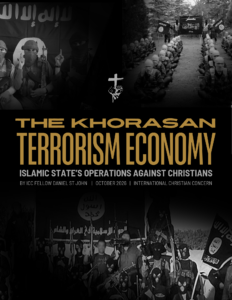
ICC’s new report, The Khorasan Terrorism Economy: Islamic State’s Operations Against Christians, shows why this matters.
The report examines the financial architecture supporting Islamic State Khorasan Province (ISKP), including links involving Islamic State networks in Somalia and Yemen, financial leadership, cryptocurrency, sanctions, and the practical challenges governments face in tracing and disrupting illicit transactions. It also examines ISKP operations against Christians, including case studies of attacks on Christian targets.
The core lesson is straightforward: terrorism cannot survive without resources. Military and law-enforcement operations can degrade terrorist capabilities, but lasting success also requires cutting off the money, materials, logistical systems, and commercial networks that enable extremist groups to recruit, operate, and spread violence.
This is not an isolated regional problem. ICC’s broader research has documented similar terrorism economies elsewhere.
Our report on East and Central Africa traces how al-Shabab and Islamic State affiliates turn revenue into recruitment, weapons, supplies, and operations against Christians.
Our research on Nigeria outlines how Islamic Fulani militants, ISWAP, and Boko Haram similarly use financial networks that involve taxation, kidnapping for ransom, commercial channels, cryptocurrency, and cross-border links among Islamic State affiliates.
Taken together, these reports point to a global system in which extremist organizations learn from one another, move resources across borders, and exploit gaps in enforcement.
Recent international efforts to target the funding mechanisms behind state and non-state sponsors of terrorism reinforce an important principle: governments must follow the money.
The international community should treat terrorism financing with the same urgency it applies to other threats to global security, as the United States did with Iran and supporters of Iran.
Governments should do the following:
-
Strengthen and enforce sanctions against individuals and entities that knowingly support terrorist organizations by revoking visas, freezing assets, and removing diplomatic protections.
-
Adopt measures to hold non-state actors accountable.
-
Increase international intelligence sharing on terrorist-financing networks and cross-border transactions.
-
Expand efforts to identify and dismantle front companies, illicit commercial pipelines, extortion systems, and other revenue streams.
-
Strengthen anti-money-laundering and counterterrorism-financing safeguards while improving the technical capacity to trace cryptocurrency and other digital assets.
-
Impose meaningful consequences on actors that facilitate the flow of money, weapons, or material support to extremist groups.
-
Work collaboratively across borders so terrorist organizations cannot exploit regulatory gaps, weak enforcement environments, or disconnected financial systems.
-
Apply diplomatic and economic pressure to governments to hold groups accountable within their borders.
For persecuted Christian communities and other vulnerable populations, terrorist financing is not merely a policy concern. It has deadly consequences. Revenue becomes recruitment, weapons, mobility, propaganda, and operational capacity. When those financial lifelines remain intact, attacks continue, communities are displaced, families lose loved ones, and religious freedom is further suppressed.
ICC’s research also shows that governments cannot rely solely on slow, manual, or fragmented approaches to financial tracing. Public agencies need the expertise, technology, intelligence partnerships, and private-sector cooperation to quickly identify suspicious networks and act before funds become violence.
ICC urges world leaders to pursue a coordinated global strategy against terrorist financing wherever it exists. The world cannot afford a selective approach. Every network that materially sustains terrorism should face lawful, decisive, and sustained pressure, while governments work together to close the financial channels that allow extremist organizations to survive and expand.
Shawn Wright
President, International Christian Concern (ICC)
To read more news stories, visit the ICC Newsroom. For interviews, please email us. To support ICC’s work around the world, please give to our Where Most Needed Fund.