
Polycarp: When Loyalty to Christ Was Tested by Fire
Stephen’s story does not stand alone. It began a pattern that would repeat itself across generations.
The gospel continued to spread. And wherever it spread, it confronted the powers, loyalties, and idols of the world.
In the Roman Empire, this tension became unavoidable. To say “Jesus is Lord” was not merely a statement of personal belief. It was a declaration that directly challenged Caesar’s authority. And the empire would not tolerate divided allegiance.
A Bishop in an Age of Pressure
By the middle of the second century, the church had grown significantly. Communities of believers were scattered across cities throughout the Roman world. But so was opposition. Persecution was not always constant, but it was always possible.
At any moment, believers could be called to prove their loyalty to the empire. And the test was simple: Offer incense to Caesar, declare him lord and live, or refuse and face the consequences.
It was in this world that Polycarp lived. He served as the bishop of Smyrna, one of the seven churches mentioned in the book of Revelation. A disciple of the apostle John, he had received the faith not as distant teaching, but from those who had walked with Christ themselves.
By the time his final trial came, he was already an elderly man, and the faith he had faithfully preserved for decades was now being tested.
A Shepherd of Truth in a Time of Confusion
Polycarp is remembered not only for the manner of his death, but also for the faithfulness of his life and the clarity of his teaching during a time when the church was already beginning to face internal doctrinal confusion.
As one of the earliest post-apostolic leaders, he stood as a crucial bridge between the apostles and the next generation of believers, preserving and transmitting the teachings he had received directly from those who had walked with Christ.
His best-known writing, the Letter to the Philippians, reveals a man deeply formed by Scripture and wholly committed to the truth of the gospel.
Throughout this letter, Polycarp exhorts believers to remain steadfast in their faith, to pursue righteousness, and to endure suffering with patience and hope rooted in Christ.
“Let us therefore be imitators of his patience; and if we suffer for his name’s sake, let us glorify Him.” (Polycarp, Letter to the Philippians, 8.1)
For Polycarp, suffering was not an unexpected disruption of the Christian life, but a natural expression of following Christ faithfully in a fallen world. His teaching consistently called believers to hold fast to the apostolic message, to reject false doctrine, and to live lives marked by holiness, endurance, and obedience.
In another striking statement, Polycarp warns against those who distort the person and work of Christ, writing, “Everyone who does not confess that Jesus Christ has come in the flesh is antichrist.”
(Letter to the Philippians, 7.1)
This strong language reflects the early church’s awareness that theological compromise was not merely an intellectual issue, but a spiritual danger that could undermine the faith’s foundation.
Polycarp understood something that remains essential for the church today: Faithfulness to Christ cannot be separated from faithfulness to truth.
Truth Before Courage
The early church historian Irenaeus preserved a well-known account of an encounter between Polycarp and the prominent heretic Marcion, who rejected large portions of Scripture and promoted a distorted view of God and the gospel.
According to Irenaeus, Marcion once approached Polycarp and asked, “Do you recognize me?” Polycarp responded with remarkable clarity: “I recognize you as the firstborn of Satan.” (Irenaeus, Against Heresies, 3.3.4)
This response may sound severe to modern ears, but it reflects how seriously the early church guarded the truth of the gospel. For Polycarp, false teaching was not a minor disagreement; it was a direct threat to the church’s faithfulness to Christ.
This moment reveals something deeply important. Before Polycarp stood firm in the face of persecution, he stood firm in the face of doctrinal compromise. Before he resisted the pressure of the Roman authorities, he resisted the distortion of the gospel within the church. A church that loses its grip on truth will not have the strength to endure suffering.
The Arrest
When persecution intensified in Smyrna, believers began to be arrested. Some stood firm. Others faltered under pressure. Eventually, the authorities came for Polycarp. At first, he withdrew for a time, encouraged by others to remain hidden. But when they found him, he did not resist.
When the soldiers arrived, they expected fear, but found peace instead. Polycarp welcomed them. He ordered food and drink to be set before them. And then he asked for time. Not to plan an escape. But to pray. For two hours, the elderly bishop stood and prayed. Not for himself. But for the church. For believers across the world. For those who were persecuting him. Even the soldiers were moved. They began to question why such a man had to die.
The Trial
The account of Polycarp’s martyrdom is preserved in one of the earliest Christian documents outside the New Testament, known as The Martyrdom of Polycarp, written shortly after his death by members of the church in Smyrna.
When Polycarp was brought before the Roman proconsul, he was given a clear opportunity to save his life by renouncing Christ and demonstrating loyalty to Caesar.
The proconsul urged him, “Swear by the fortune of Caesar … repent, and say, ‘Away with the atheists.’” (Martyrdom of Polycarp, 9) In response, Polycarp looked at the crowd of those who rejected the true God and, with calm conviction, gestured toward them and said, “Away with the atheists.”
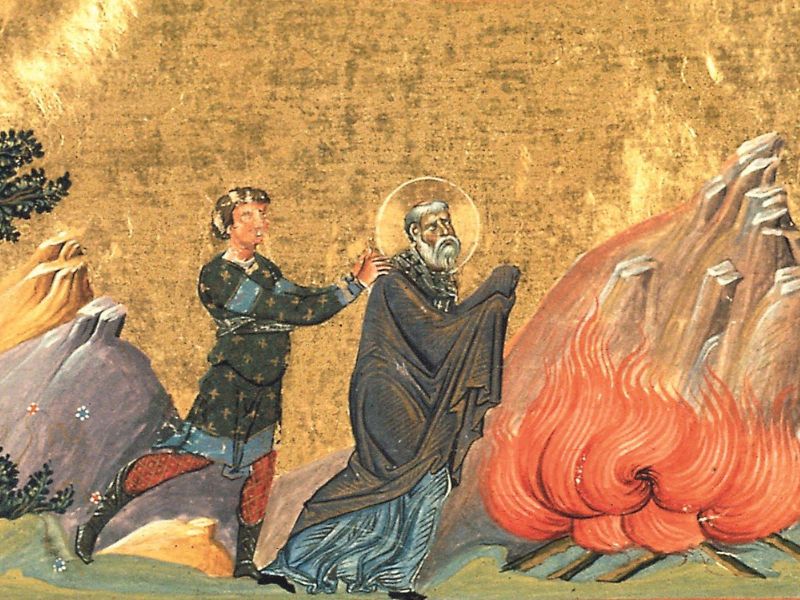
The proconsul persisted, giving him another opportunity: “Swear, and I will release you. Curse Christ.” Polycarp’s reply has echoed through the centuries as one of the clearest declarations of Christian allegiance: “Eighty-six years I have served him, and he has done me no wrong. How can I blaspheme my King who saved me?” (Martyrdom of Polycarp, 9)
This statement was not a sudden emotional decision, but the expression of a lifetime of faithful discipleship. When threatened further with execution by fire, Polycarp responded with words that revealed his eternal perspective: “You threaten me with fire that burns for a time and is soon extinguished, but you do not know the fire of the coming judgment …” (Martyrdom of Polycarp, 11)
There was no fear in his response, no hesitation, and no attempt to negotiate. Only clarity. Only conviction.
A Life Offered
As Polycarp was led to his execution, the account records that he did not resist, but instead responded with prayer and thanksgiving, recognizing that his suffering was not meaningless, but part of his participation in the life of Christ.
He prayed, “O Lord God Almighty … I bless you that you have counted me worthy … to share in the cup of your Christ.” (Martyrdom of Polycarp, 14) This is the culmination of his life. The theology he had taught, and he now embodied.
The Witness That Could Not Be Silenced
Polycarp’s life reveals something essential: Truth produces endurance. And endurance produces witness. A church that stands firmly in truth will be able to stand firmly in suffering. But a church that compromises the truth will struggle to remain faithful under pressure.
Their Blood Still Speaks
Polycarp’s life and death speak with clarity across the centuries. Not only of courage. But of conviction. Not only of endurance. But of truth. And his witness asks the church today: What kind of faith are we building? A culturally acceptable faith? Or a faith that is anchored in Christ and able to endure?
The Question Before the Church
Polycarp’s faithfulness did not begin in the arena. It was formed over decades. In teaching. In obedience. In guarding the truth. His martyrdom did not create his faith. It revealed it. And this raises a question for the church today:
What kind of disciples are we forming?
Are we preparing believers for comfort or for faithfulness? Are we grounding them in truth or allowing them to drift with the culture?
Are We Willing to Pay the Cost?
Polycarp was given a clear choice: Deny Christ and live. Remain faithful and die. He chose Christ. Because long before that moment, he had already decided that Christ was worthy.
The church today must ask:
Is our faith shaped by convenience or by conviction?
Is it visible?
Is it costly?
Is it anchored in truth?
Because the witness continues, and their voices are not silent.
And the question remains: If the blood of the martyrs still speaks, are we listening?
Click here to read more from the series.
To read more news stories, visit the ICC Newsroom. For interviews, please email us. To support ICC’s work around the world, please give to our Where Most Needed Fund.