
Lebanese Christians Stuck Between Mortal Enemies
Lebanon has the highest proportion of Christians anywhere in the Arab World and arguably the region’s least restrictive laws on religious freedom.
Lebanese Christians also have important positions in society. This includes the presidency, which is reserved for a Christian under the nation’s political power-sharing system among the three main religious demographics: Christians, Sunni Muslims, and Shia Muslims.
Though the Lebanese government has sought to avoid religious discrimination, a significant number of Christians are caught in the crossfire between Israeli military strikes and Hezbollah — a Lebanese Shia Muslim political and military organization that has received funding, weapons, training, and ideological reinforcement from Iran for the last several decades.
Conflict with Israel
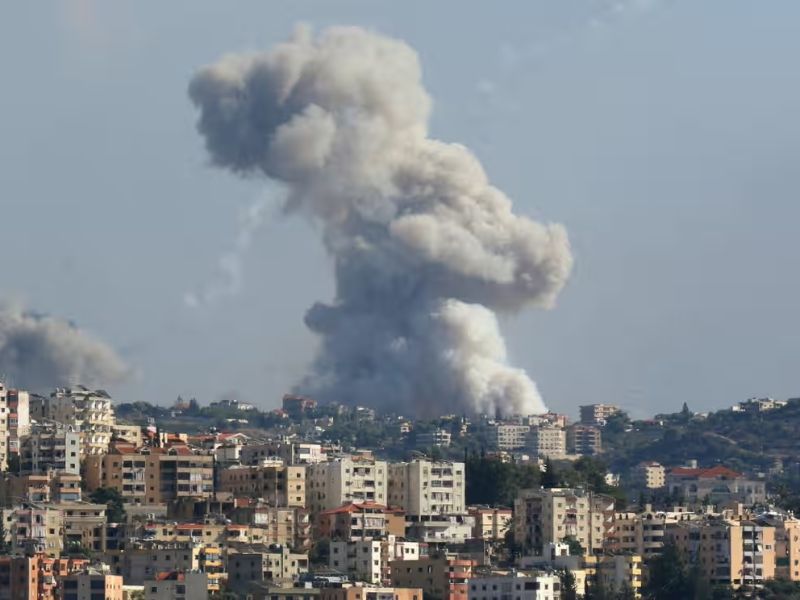
The most recent conflict with Israel has seen thousands of deaths and 1 million people displaced across Lebanon, most of them from the southern part of the country near the Israeli border.
Israeli attacks and counterattacks, ostensibly against Hezbollah, have seen some majority-Christian communities in southern Lebanon all but decimated.
Drawing particular scrutiny has been Israel’s use of white phosphorus munitions, which can cause severe burns and render land uninhabitable.
“Anthony,” a Lebanese Christian man, said that both Hezbollah and Israel are disliked by most Christians in his country. But, in his view, Israel is “slightly more” disliked at this point.
Views on Hezbollah and Israel do not always divide neatly according to religious demographics. “Therese,” a Lebanese Christian woman, said that even within her own family, many people have different opinions.
A significant portion of Lebanese — including some Christians — believe that Israel would like to annex Lebanon, and that Hezbollah is necessary because the Lebanese military would be unable to effectively defend the country.
 “Hezbollah enthusiasts believe they’re the only reason Lebanon still has sovereignty, and [they] look at everyone else like we’re insane for reproaching them,” Therese said.
Due to its ongoing support from Iran, Hezbollah is better-armed than Lebanon’s actual military. This places the country in what can seem like an impossible situation.
“America expects us to disarm Hezbollah or face the consequences, but [Lebanon’s] government does not have that power,” Therese said.
At the start of the 2020s, support for Hezbollah had been dropping significantly, even among Shia Muslims. But this trajectory was disrupted amid the Israeli military strikes of more recent years. These strikes have seemingly prompted some Lebanese, particularly Shia Muslims, to rally around Hezbollah.
Different Viewpoints
Though a minority of Christians supports Hezbollah, Therese said there’s a frequent viewpoint among Christians that if Hezbollah “didn’t go and provoke Israel” then there would be no conflict.
While making it clear that most Lebanese Christians “aren’t exactly willing to trust Israel with open arms,” she said, “there’s actually a great number of Lebanese Christians who would rather make peace with Israel than have to deal with Hezbollah any longer.”
But such a viewpoint is one you must “keep under wraps,” Therese said. Otherwise, you will be labeled as pro-Israel or even a collaborator.
Anthony agreed that most Lebanese see Hezbollah as something that pulls their country into ongoing conflict.
Even among Shia Muslims, Therese thinks a sizable minority of them would prefer that Hezbollah “back down so we can live in peace.”
Hezbollah, though, does not seem inclined to “back down,” at least not while it receives support from Iran. If the Iranian regime were to fall, however, it would “be a great start for neutralizing Shia extremists and dismantling Hezbollah too,” she said.
Anthony said he thinks that a collapse of the Iranian regime would weaken Hezbollah but might not necessarily bring an end to the group.
Neither of them seemed optimistic about the chances of a truly unified Lebanon.
A Declining Population
Geographically about half the size of New Jersey, Lebanon has a population of 5.9 million people. The U.S. Department of State reported that about 31% of the country is Christian, 31% Sunni Muslim, and 32% Shia Muslim. Other sources vary considerably, as Lebanon has not conducted a census in almost 100 years.
A pro-Hezbollah newspaper sparked controversy in 2024 when it ran a survey and claimed that less than 16% of the population is Christian. These statistics are politically sensitive: Lower percentages of Christians could be used to argue that Christians should receive a smaller share of political representation.
These stats are also sensitive because, even if you doubt the pro-Hezbollah survey, the Christian population is indeed declining. Lebanon was once a majority-Christian nation, with some 70% of the population Christian. By any estimate, that number has shrunk significantly.
In public settings, relations between Christians and Muslims are mostly cordial, Therese said. But she has observed minor controversies that lead to outbursts of genuine animosity.
Anthony hesitated to estimate the portion of Lebanon’s Muslim population that genuinely detests Christians, but said, “it’s quite a large number.”
“I wouldn’t say they all hate us,” Therese said. But she suspects that, as a group, “if they had the option, they’d throw all of us out.”
At this point, though, leaving the country is a goal of many, if not most, younger Lebanese Christians.
Lebanon has been mired in economic crisis since 2019. While such conditions have affected all demographics, they have particularly troubled the nation’s professional class, which Christians heavily represent.
“I’ve built my career in a way that maximizes my chances of leaving,” said Therese, adding that every young Christian adult she knows has “an escape plan.”
Meanwhile, Anthony expects that Lebanon’s Christian population “will keep decreasing.”
Story by R. Cavanaugh
To read more news stories, visit the ICC Newsroom. For interviews, please email us. To support ICC’s work around the world, please give to our Where Most Needed Fund.