
A Biblical Focus on Persecution

By Greg Cochran, PhD, ICC Fellow
Recently, International Christian Concern (ICC) released a report on religious liberty in Morocco.
According to that report, three areas of persecution still restrict freedom for Christians and minorities there:
“Freedom of Religion in Morocco identifies three major areas of concern: the enforcement of Ramadan, restrictions on religious conversion from Islam, and burial practices. It also shows how Islam is constitutionally privileged, and how other provisions limit religious dissent.”
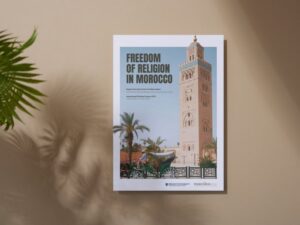 Mention of the report belongs here not on account of its novelty, but rather on account of the ubiquitous nature of such occurrences. Allured by promises of Western trade, formation of economic alliances, and the signing of prosperous treaties, nations around the world have regularly adopted the language of human rights and religious freedom, while leaving the devil to appear in the details.
For more than three-fourths of a century, the concept of human rights has been promoted, accepted, and even encouraged around the world. This remarkable accomplishment was achieved in part by First Lady Eleanor Roosevelt, who led a coalition of world leaders to adopt a U.N. Declaration on the matter. Since then, human rights language has shone into this dark world as a beacon of hope radiating outward from the Palais de Chaillot in Paris, France, where the declaration was signed in December of 1948.
No doubt, this work by Roosevelt and others has had a positive effect during these 75 years. Encouraged by the success, the U.N. adopted another declaration 33 years later. Much less known — yet even more ambitious — the Declaration on the Elimination of All Forms of Intolerance or Discrimination on the Basis of Religion or Belief was launched in November 1981 with the hope of eradicating religious violence altogether.
Of course, religious violence has not been eradicated — and might be increasing. Human rights are not guaranteed worldwide. Yet these declarations — these meta-level enterprises for good will — ought to be enjoined by Christians and advocates of good will. They probably serve a role more important than most policymakers realize.
The overall impact of such initiatives proves good in the way that locks prove good on doors. While bad actors will break the locks, honest people will likely honor them and be deterred from evil. Locks make a statement. Declarations of human rights make a statement. They put a word of righteousness in the air.
As noted above, ICC applauds efforts like these to broaden religious liberty. Christian organizations like ICC should continue to serve as cheerleaders for broader efforts for religious liberty. ICC rightly decries forms of religious intolerance. And ICC partners with important institutions like the USCIRF, IRF, and the U.N. Special Rapporteur on Freedom of Religion or Belief.
And yet, ICC doesn’t aim for such declarations and organizations to complete its work. Organizations like ICC must always narrow their beams to focus back on the persecution of Christians — for reasons noted in the report from Morocco.
Politically and constitutionally, Christians have religious liberty in Morocco. Realistically, persecution still takes place to one degree or another. The fight for religious liberty won’t always overlap precisely with ministry to and advocacy for persecuted Christians. Therefore, the focus on persecution cannot be surrendered, even while cooperation on declarations might be enjoined.
In the mid-to-late-20th century, popular theologian Francis Schaeffer began using the phrase “cobelligerents” for situations such as this. In his little book titled “The Church Before the Watching World,” Schaeffer provided a distinction between a political ally and a political cobelligerent.
In the latter case, the cobelligerent doesn’t align himself with any aim of his political partner outside of the narrow, usually singular issue of their cobelligerence. Christians might work together with Moroccan Muslims to guarantee religious liberty in their constitution but not align themselves with economic, military, or trade interests.
The concept is simple. Each party maintains focus on its self-interest while cooperating toward a common, agreeable outcome on an issue of mutual interest. Evangelicals surfed Schaeffer’s concept of cobelligerence through many waves of conservative and liberal tides — trying not to align completely, while still building momentum toward the right outcome. And so, advocates for religious liberty will be cobelligerents with advocates for the persecuted — and vice versa.
But there are many reasons for organizations like ICC to remain laser-focused on persecution as the baseline concern. Here again, the work of ICC in Morocco illuminates the point. How many cameras, reporters, newsreels, and onlookers covered Eleanor Roosevelt at the Palais de Chaillot in Paris? And how many covered the release of the report from ICC and the Regent University Center for Global Justice? Each event mattered.
For the Christian, persecution support looms large throughout the New Testament as a first-order priority. As ICC has noted before, the very design of Christian Sunday offerings came about to serve the needs of suffering saints. The Apostle Paul devoted enormous energy in his missionary journeys collecting for Christians in need.
No stranger to persecution, Paul expected persecution to be part of the Christian experience on earth. As he wrote to his disciple Timothy late in life, “Indeed, all who desire to live a godly life in Christ Jesus will be persecuted, while evil people and impostors will go on from bad to worse, deceiving and being deceived” (2 Tim. 3:12-13, ESV).
To the Colossians, Paul made it sound as though time itself were a mere stage on which persecution would be worked out in the lives of faithful saints:
“Now I rejoice in my sufferings for your sake, and in my flesh I am filling up what is lacking in Christ’s afflictions for the sake of his body, that is, the church, of which I became a minister according to the stewardship from God that was given to me for you, to make the word of God fully known, the mystery hidden for ages and generations but now revealed to his saints” (Colossians 1:24-26, ESV).
The sufferings in view in this passage do not reference Christ’s atonement. In Romans 3 and elsewhere, both Paul and other New Testament writers make plain that Christ’s sacrificial atonement was complete as a penal substitution for his people. Rather, as Paul notes in the verses, the suffering is Christ’s continuing presence on earth through his church. Missionaries, pastors, servants in hostile places continue to absorb the afflictions of hostility against Christ himself. (See Acts 9 for a personal retelling of how Paul learned this lesson from Christ — as the Lord makes plain that Paul is persecuting him when he persecutes the church.)
The Book of Revelation shares a similar perspective with Paul. In the altar scene of Revelation 6:9, the martyred saints — those beheaded for their faith — cry out, “With a loud voice, ‘O Sovereign Lord, holy and true, how long before you will judge and avenge our blood on those who dwell on the earth?’” The Lord’s reply marks the time: “They were each given a white robe and told to rest a little longer, until the number of their fellow servants and their brothers should be complete, who were to be killed as they themselves had been” (Revelation 6:12, ESV). Time displays the persecution Christ’s church will suffer.
The writers of the New Testament seem to think that this space-time arena we humans inhabit exists for nothing short of the display of Christ’s redemption — as though everything in creation were created by Christ and for his glorious purposes.
His redemptive work guarantees his triumphant return for his saints, as Revelation states (19:6-8, ESV),
“Then I heard what seemed to be the voice of a great multitude, like the roar of many waters and like the sound of mighty peals of thunder, crying out,
“Hallelujah!
For the Lord our God
the Almighty reigns.
Let us rejoice and exult
and give him the glory,
for the marriage of the Lamb has come,
and his Bride has made herself ready;
it was granted her to clothe herself
with fine linen, bright and pure” —
for the fine linen is the righteous deeds of the saints.”
The steadfast, covenant love of Christ will secure victory for the righteous and, equally important, justice for the wicked. The same Lamb who invites his followers to his feast will prove a terror to the wicked, as Revelation 6:15 says,
“[the powerful persecutors and privileged authorities] hid themselves in the caves and among the rocks of the mountains, calling to the mountains and rocks, ‘Fall on us and hide us from the face of him who is seated on the throne, and from the wrath of the Lamb, for the great day of their wrath has come, and who can stand?’”
Same Lamb. Very different redemptive results.
Persecution is neither rare nor casually addressed in the Christian scriptures. It reflects the reality that Christ claims kingship authority. In his kingship authority, Christ claims that he alone fulfills the righteousness of God. Hostile authorities — like King Herod during the birth of Christ — wield the power of fear and death to at least downplay if not outrightly defy the righteous authority of Christ. Persecution is an assault on Christ. Where Christ’s people are suffering for his righteousness, they are at the same time displaying his redemptive work. According to Revelation, Christ will complete this redemptive work with a perfect mix of covenant love (for his saints) and righteous judgment (for the persecutors).
The point of focused persecution organizations is like the point of a Declaration of Human Rights: the word gets into the air because it reflects something real — even if that reality is not fully embraced.
Christians are and ought to be cobilligerents in a vast array of good works designed to help human beings thrive on earth as God intended. Nevertheless, the priorities of nations and news organizations won’t sense the significance of a father in Nigeria crying out as David did in Psalm 13, “How Long, O Lord!” The New Testament assures the saints that Christ hears such cries, takes them to heart, and will make them right.
When persecutors attack the saints, they attack Christ himself. When advocates love the saints, we’re loving Christ so the world will know.
To read more news stories, visit the ICC Newsroom. For interviews, please email us. To support ICC’s work around the world, please give to our Where Most Needed Fund.