
Climate Change Is Not Christian Persecution, So Why Does It Matter?
Part One of the series, “When Creation Groans”
By ICC Fellow Lisa Navarrette
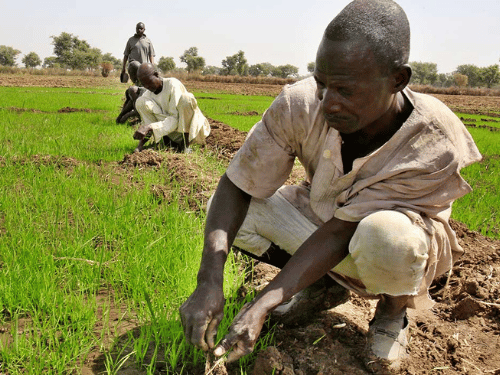
The first light of dawn stretches across a farming village in Nigeria’s Middle Belt as Samuel walks slowly through the field his father once cultivated before him.
He kneels and scoops a handful of dry soil into his palm. Another rainy season arrived late. Another harvest has fallen short. His wife has quietly begun serving smaller meals, hoping their children won’t notice. At church, conversations that once centered on weddings, baptisms, and harvest celebrations have increasingly turned toward rising food prices, failing crops, and neighbors forced to leave in search of work. Samuel isn’t thinking about climate reports. He’s wondering whether next season will be enough to keep his family on the land they have called home for generations.
Nearly 7,000 miles away, another Christian family stands outside a storm-damaged home along the Gulf Coast of the United States. Hurricane-force winds ripped away part of the roof, floodwaters entered the first floor, and trees now block the driveway. Yet before sunset, utility crews begin restoring power. Insurance adjusters schedule inspections. Churches organize volunteer teams. Local, state, and federal agencies mobilize emergency resources to help families begin rebuilding. Both families experienced a climate-related disaster. Only one lives where recovery itself is uncertain. The difference is not simply geography. It is the difference between resilience and fragility.
Around the world, climate change affects every nation, but it does not affect every nation equally. Communities with stable governments, resilient infrastructure, functioning markets, and emergency resources often recover from environmental disasters with remarkable speed. Communities already struggling with poverty, corruption, armed conflict, or weak institutions frequently cannot. In those places, a drought, flood, or failed harvest becomes more than an environmental event; it becomes the beginning of a humanitarian crisis.
For Christians living in many of these regions, those hardships rarely occur in isolation. Climate change does not persecute Christians. People persecute Christians. Extremist organizations, authoritarian governments, criminal networks, and hostile communities are responsible for acts of religious persecution. Yet environmental pressures can intensify the humanitarian, economic, and political conditions that make persecution easier to carry out and far more difficult for victims to recover from. This distinction is essential to understanding the challenges facing many Christian communities today.
This series explores that intersection. It does not argue that climate change causes persecution. Rather, it examines how environmental stress can deepen existing instability in countries where Christians already face violence, discrimination, and displacement.
Climate Change Beyond the Headlines
For many people in North America and Europe, discussions about climate change quickly become political. Headlines often focus on carbon emissions, renewable energy, or international agreements. While those debates have their place, they can unintentionally overshadow the everyday realities experienced by millions of people whose greatest concern is not climate policy but survival.
According to the Intergovernmental Panel on Climate Change’s Sixth Assessment Report, rising global temperatures are contributing to changing precipitation patterns, more frequent and intense heatwaves, prolonged droughts, heavier rainfall events, and rising sea levels. Although these changes affect every continent, their consequences are often most severe in countries with the fewest resources to prepare for or recover from them.
For a commercial farmer with irrigation systems, crop insurance, and government assistance, a delayed rainy season may result in financial loss. For a subsistence farmer in northern Nigeria, South Sudan, or rural Kenya, that same delay can determine whether an entire family has enough food to survive until the next harvest.
The World Bank’s Groundswell report estimates that climate change could force up to 216 million people to migrate within their own countries by 2050 if meaningful adaptation measures are not implemented. Behind that staggering number are individual families making impossible decisions — leaving ancestral farmland, relocating after repeated flooding, or searching for work because local agriculture can no longer sustain them. Climate change is not simply reshaping landscapes. It is reshaping lives.
Why Fragility Matters
Natural disasters occur everywhere. Wildfires have devastated communities in California and Greece. Floods have struck Germany, Pakistan, and China. Hurricanes regularly batter the Caribbean and the southeastern United States. The difference is often not the disaster itself; it is the ability to recover. The United Nations High Commissioner for Refugees (UNHCR) warns that climate-related hazards increasingly intersect with armed conflict and forced displacement, creating humanitarian emergencies that are far more difficult to resolve than either challenge alone. Likewise, the United Nations Office for Disaster Risk Reduction (UNDRR) emphasizes that disasters become catastrophes when vulnerable communities lack the capacity to prepare for, withstand, and recover from them.
In fragile states, one failed rainy season can trigger a chain reaction. Harvests decline. Food prices rise. Livestock dies. Families migrate. Communities compete over shrinking natural resources. Public confidence in already fragile institutions begins to erode. Security analysts increasingly describe climate change as a threat multiplier. It does not create terrorism, armed conflict, or religious persecution. Rather, it magnifies existing vulnerabilities, placing additional strain on societies already facing economic hardship, political instability, or violent extremism.
That distinction is critical. Without it, we risk misunderstanding both climate change and Christian persecution.
When Environmental Stress Meets Existing Persecution
This is where the story becomes more personal. International Christian Concern (ICC) has documented numerous attacks on Christian farming communities in Nigeria’s Middle Belt, where many families depend on agriculture not only for income but for survival.
In ICC’s report “Harvesting Hope in Nigeria,” Christian families describe losing their homes, churches, and farmland during violent attacks carried out by armed militants. For many survivors, rebuilding was about far more than replacing a house; it meant trying to restore an entire way of life.
Those attacks were acts of persecution. Climate change did not cause them. According to the Food and Agriculture Organization of the United Nations (FAO), changing rainfall patterns, land degradation, and growing pressure on productive farmland are making it harder for many rural communities to sustain their livelihoods. Families who lose their farms to violence may discover that finding new land is not easy. The available farmland may be less productive, more expensive, or already under pressure from growing populations and environmental change.
The result is a reality that cannot be explained by climate science alone or by religious persecution alone. It is the intersection of both. And it is at that intersection where many Christian communities now find themselves living.
Seeing the Whole Picture
News reports often focus on a single event — a church set on fire, a pastor kidnapped, or families fleeing after an attack. Those stories deserve attention because they reveal the immediate reality of Christian persecution. Yet they rarely tell the whole story.
Behind many headlines are communities already struggling with food insecurity, limited economic opportunities, or repeated environmental shocks. A family displaced by violence may return to discover that their crops have failed after months of drought. Another family may escape an attack only to find overcrowded camps where food, clean water, and medical care are scarce. These hardships are not acts of persecution themselves, but they shape how families recover and whether they can rebuild their lives.
ICC has repeatedly highlighted that supporting persecuted Christians involves more than responding to violence. In many regions, churches help provide emergency food, temporary shelter, trauma care, and assistance rebuilding homes and livelihoods after attacks. Those efforts recognize an important reality: persecution does not end when the violence stops. Recovery often takes months or even years, especially where communities are already facing economic hardship and environmental pressures. Looking at persecution through this broader lens does not diminish the courage of those who endure it. Instead, it helps us better understand the full range of challenges facing believers who remain faithful under extraordinarily difficult circumstances.
Why This Matters to the Global Church
For Christians living in countries where religious freedom is largely protected, the relationship between climate change and persecution may seem distant. Yet Scripture reminds believers that when one part of the Body of Christ suffers, all suffer together (1 Corinthians 12:26). Standing with persecuted Christians begins by understanding the realities they face.
Climate change is not replacing persecution as one of the church’s greatest challenges. Rather, in many fragile regions it is adding another layer of hardship to communities already living under pressure. When Christians understand the distinction, they can pray more specifically, advocate more effectively, and support ministries that address both the immediate effects of persecution and the long process of recovery.
It also reminds us that persecuted believers are far more than victims of isolated attacks. They are parents raising children, pastors serving congregations, farmers cultivating their fields, and communities striving to remain faithful despite extraordinary obstacles. Their stories deserve to be understood in their entirety. Perhaps the most important lesson from this discussion is that persecution rarely exists in isolation. It unfolds within a broader context shaped by economics, governance, conflict, and humanitarian challenges. Climate change is one part of that larger picture because it can intensify the conditions in which persecuted communities struggle to survive and rebuild.
To see how environmental pressures affect daily life, we must move beyond the global picture and into the experiences of individual communities. In Part Two, we’ll travel to Nigeria, Sudan, and Kenya to examine how drought, displacement, and food insecurity are reshaping the lives of Christian families — and why those changes matter for the future of religious freedom.
To read more news stories, visit the ICC Newsroom. For interviews, please email us. To support ICC’s work around the world, please give to our Where Most Needed Fund.