
Christians in Bangladesh Hold Onto Fragile Stability Following Elections
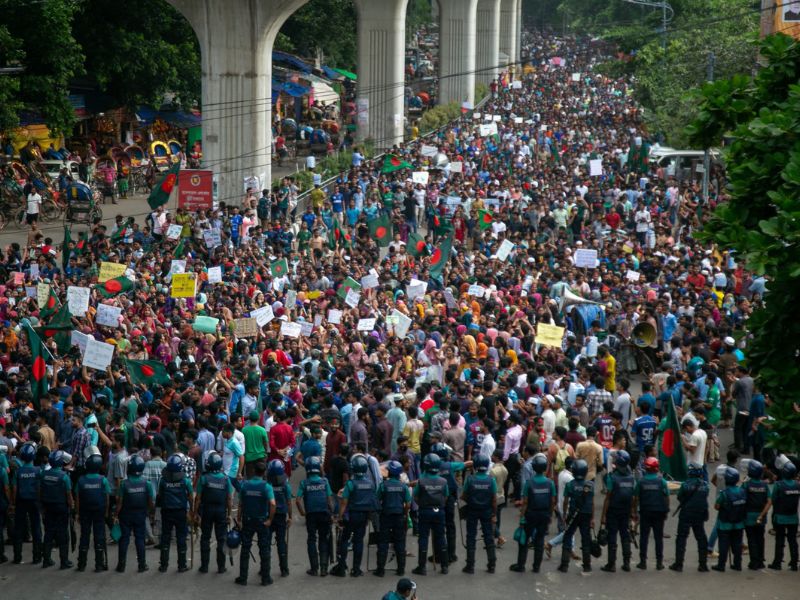
Following the August 2024 ousting of Bangladesh’s longtime leader Sheikh Hasina, the country fell into a power vacuum. Amid the ensuing upheaval, some people in this nation of 175 million (91% Muslim, 8% Hindu, and about half of 1% Christian) seized the opportunity to attack religious minorities.
“Christopher,” a Catholic in Bangladesh, said there were many such attacks in late 2024. Now in his early 20s, he was still a teenager then. “During that period, my family was afraid for our safety … and my parents kept me at home,” he said.
“It was very bad,” said “Gabriel,” a Bangladeshi Christian rights activist who escaped his home country and now lives in the United States.
Gabriel said that, during the power vacuum, extremists had a hit list. His name happened to be on it.
On the day in August 2024 that former Prime Minister Hasina was driven from power, Gabriel’s house burned down. He had escaped the area just in time, thanks to a friend from church who came by with a motorcycle and a helmet with a face shield that enabled him to conceal his identity. Gabriel’s wife was also with him, wearing a hijab to conceal her identity, as they sped away from the village and a group coming to do violence.
There were some dangerous people in pursuit: Amid the breakdown of central authority and a general lack of police presence, Gabriel said extremist Muslims broke into the jails and liberated fellow extremists. These extremist escapees celebrated their newfound freedom by joining the hunt.
Gabriel said the extremists pursued their hit list for a few months, hunting for vocal Christians and Hindus, leaving behind a trail of damaged churches and temples. Several locally prominent Hindus were killed.
Fleeing to India with almost no possessions, Gabriel said he received generous treatment from Indian Christians and was eventually able to fly to the United States.
In Bangladesh, an interim government helped restore order and, at least ostensibly, made some effort at arresting perpetrators of violent attacks on religious minorities (primarily Hindus, who are by far the largest minority) during the power vacuum.
From what Gabriel can determine, though, criminal convictions have remained elusive. He added that Bangladesh has “a large number of Muslims who are not happy with what took place” regarding the targeting of religious minorities in late 2024. But almost all of them “are afraid to speak out,” he added, acknowledging that they could also end up on a hit list.
In February 2026, Bangladesh had its first national election since the country all but fell apart. In this pivotal election, Jamaat-e-Islami, the nation’s hardline Islamist political party, won the second-most seats in the country’s parliament, behind the victorious Bangladesh Nationalist Party (BNP).
Gabriel said it is better for religious minorities to have the BNP in power and that he had encouraged other Christians to vote for the BNP.
The real concern for Christians and Hindus was that Jamaat-e-Islami would come to power. Gabriel described the party’s members as “very much fundamental” and “very aggressive,” adding that “we cannot trust them.”
From 2013 to 2025, Jamaat-e-Islami was prohibited from participating in electoral politics due to a court ruling that the party conflicted with Bangladesh’s constitution, which includes secularism as a fundamental principle.
Christopher’s family voted for the Bangladesh Nationalist Party, which won the national election by a decisive margin. But they and other minorities have noticed that the Jamaat-e-Islami party is gaining popularity. It now holds several times as many seats in parliament as it had 20 years ago.
“Personally, I am concerned about the future,” Christopher said. “I worry that I could lose some of the freedoms I currently enjoy.” These freedoms include dressing casually or wearing a cross necklace.
Christopher said that, from what he can observe, a slight majority of Bangladeshi Muslims are inclined to show at least some degree of hostility toward religious minorities. He has faced it personally: In high school, he was harassed and physically assaulted by peers for refusing to convert to Islam.
Now around age 60, Gabriel recalled that when he was in his 30s, he “didn’t see that much hatred toward the Christians and Hindus in the country.”
The Jamaat-e-Islami party “is leading the process of Islamization in Bangladesh,” Gabriel said. “They are stirring up religious hatred.”
Though the chaos of the power vacuum has subsided, significant tension persists, punctuated by incidents of violence.
November 2025 saw multiple incidents of homemade bombs detonated outside Catholic churches in Dhaka, the nation’s capital.
In late April 2026, two Muslim men scaled a wall to enter the grounds of a Catholic church, where they proceeded to rob and assault a priest.
Meanwhile, Gabriel said that “a lot of false criminal cases have been put on Christians,” who are now either in jail or in hiding.
He expects Islamic extremism to intensify in Bangladesh in the coming years, with a significant part of the population becoming more proactive about establishing Sharia law and ridding the country of religious minorities, one way or another.
Story by R. Cavanaugh
To read more news stories, visit the ICC Newsroom. For interviews, please email us. To support ICC’s work around the world, please give to our Where Most Needed Fund.