
Syria’s President to Visit White House in Historic First
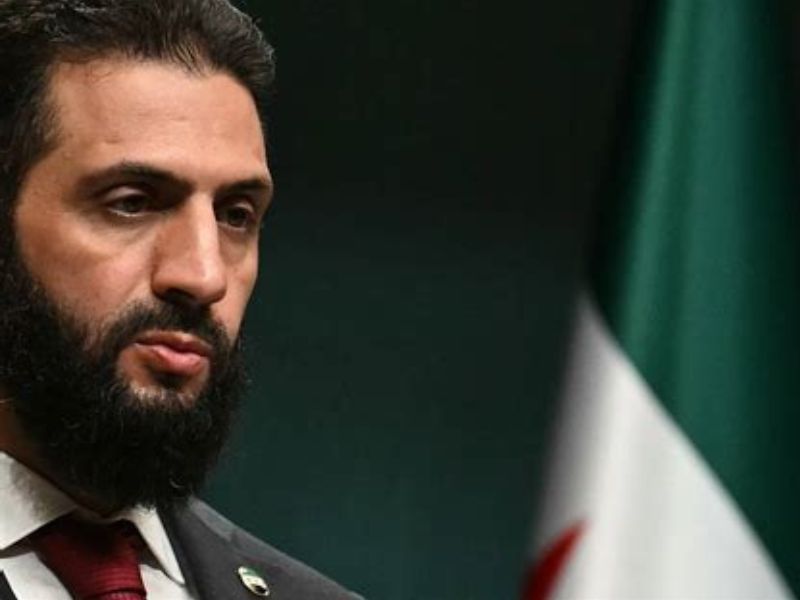
Syrian President Ahmed al-Sharaa is slated to visit the White House on Monday, marking the first-ever visit by a Syrian president to Washington, D.C., and al-Sharaa’s second meeting with U.S. President Donald Trump in recent months. Al-Sharaa seized power in December 2024 after a rapid coup that toppled longtime dictator Bashar al-Assad.
In the months since coming to power, al-Sharaa has overseen several notable changes, including initiating a nationwide constitutional reform project and proceeding with a national parliamentary election exercise in October.
Al-Sharaa has also reached out to various religious and ethnic minority groups, speaking publicly about the need for diversity and tolerance and promising to protect these vulnerable communities.
Despite these positive signs, al-Sharaa has also garnered significant criticism from minority groups and international human rights organizations, which point to the repeated massacres of Druze and Alawite civilians and the lack of representation in a new parliament chosen by al-Sharaa and small groups of local leaders as signs that the current promises of reform are at least limited, if not hollow.
The international community will watch next week’s meeting closely for signs of the U.S. policy toward Syria. While human rights and democratic freedoms were not raised during Trump’s first meeting with al-Sharaa, many are calling for those issues to feature prominently in this follow-up meeting.
This week, Reuters reported that the U.S. is preparing a military presence in Damascus to enforce a security pact being brokered between Syria and Israel.
Elsewhere, governments are warming to the new Syrian government and to its new leader. In late October, the U.K. removed HTS, al-Sharaa’s militant organization, from its list of terrorist groups to allow closer engagement with the Syrian government.
Still, leaders of the international religious freedom movement have viewed al-Sharaa’s government with increased suspicion after a consistent string of large-scale violence against minorities.
At a recent Capitol Hill event titled “Fortifying Religious Freedom in Syria,” civil society groups gathered in support of decentralization. Speakers included Nadine Maenza, Ambassador Sam Brownback, Rep. Frank Wolf, and representatives of the Druze, Alawite, Kurdish, and Christian communities.
A central theme of the event was the successful model established in the semiautonomous Kurdish region in the northeast. Panelists and keynote speakers urged U.S. policymakers and the Syrian government to safeguard this model and extend it to other minority communities.
“Their inclusion in the Syrian Government would strengthen all of Syria,” event organizer Nadine Maenza said afterward, referring to the Kurdish region in the northeast. “A united Syria, with decentralization or federalism, gives this beautiful country its best chance at peace and stability.”
Centralization Versus Federalization
Al-Sharaa is moving toward a system that grants the central government significant authority, rather than a federated system in which local areas retain robust self-determination and the right to organize their own security.
The U.S. government seems split on the issue of centralization versus federalization. U.S. Special Envoy for Syria Tom Barrack publicly favors complete integration, under which all minority communities would be fully administered by the al-Sharaa government in Damascus. He further argues that regional security forces must be absorbed into the national security forces, a move that would amount to a seismic shift of power in the country.
Some senior diplomats serving at the U.S. mission to Syria were fired in September, with media reports indicating that they were dismissed due to their support for the Kurdish-led Syrian Democratic Forces (SDF) and opposed Barrack’s efforts to integrate the SDF into the Syrian Army.
In an op-ed recently published in The Hill, Ambassador Brownback urged the international community to support decentralization in Syria.
“The transitional government’s response has been woefully inadequate,” he wrote. “Despite promises of protection, investigations have been superficial, many if not most perpetrators remain free, and in some cases government forces have themselves been implicated.”
Explaining his vision for a federal Syria, Brownback called for a system in which “Alawite, Christian, Druze, Kurdish, and Sunni-majority regions could maintain their own accountable security forces, while a central government would oversee foreign policy, the economy, and national defense.”
“This would not be easy,” he admitted, “but it could help prevent sectarian cleansing, deter extremist recruitment, and restore trust that no group will be abandoned to its enemies.”
Recent Elections
The country’s recent election did not solicit votes directly from the public; instead, it turned to local councils chosen by regional electoral bodies. A direct public vote was deemed logistically impossible at the current time, with many citizens displaced and without proper identification after decades of civil war.
Following the October vote, 119 new parliamentarians were announced. An additional 21 seats were not voted on because they represent areas not currently under government control, and the remaining 70 seats in the 210-member parliament will be appointed directly by al-Sharaa.
Only six seats went to women, and fewer than a dozen went to members of religious and ethnic minority communities. The overwhelming majority of those elected belong to the dominant Sunni majority, leading to concerns that the new parliament may usher in an era marked by Sunni nationalism.
Only a single Christian was elected, according to media reports. While Christians are largely concentrated in cities such as Damascus and Aleppo, these areas did not choose a Christian representative.
Observers, both within the country and internationally, are eagerly awaiting al-Sharaa’s 70 parliamentary appointments, originally scheduled to be announced in mid-to-late October. However, the original deadline has passed without any appointments.
Immediately after the election, Syrian government officials indicated that his appointments would seek to address some of the imbalances in the election results. Whether the appointments make good on that promise or double down on the Sunni majority already in place remains to be seen.
Inconsistent Messaging
Al-Sharaa has made many statements extolling the virtues of religious tolerance and has engaged in concrete steps to ensure their safety. “Diversity is our strength, not a weakness,” he declared in an edict upon capturing Aleppo en route to Damascus in December 2025.
Still, HTS-aligned fighters reportedly went door to door when they first captured Damascus, asking residents to identify their faith, suggesting that religion may continue to act as a point of tension. Al-Sharaa is an avowed proponent of the Salafi-jihadist ideology and has much deeper roots as a persecutor of religion than a promoter of its free practice.
Part of the inconsistent messaging may lie in the fact that al-Sharaa has always focused on opposing the Assad regime rather than clearly articulating his own positive vision for the country.
Some analysts predict that al-Sharaa’s deep roots in Islamic jihad will lead to further attacks on ethnic and religious minority communities. Sharaa began his career with the Islamic State in Iraq, before creating his own al-Qaida-aligned militant group in Syria.
Other analysts argue that al-Sharaa’s main concern will be to rebuild a country torn by decades of war — something that will require international cooperation and may incentivize al-Sharaa to respect international human rights norms.
As the international community watches to see what type of government will replace the Assad regime, hundreds of thousands of religious minorities in Syria are watching too. For them, the new government’s respect for religious freedom is an intensely personal unknown.
Should al-Sharaa continue to signal support for the rights of Christians and others, such as the Alawites and Druze, that would be a fundamental shift for the better. But that outcome is far from guaranteed, and a reversion to his old ways when he worked with the Islamic State and al-Qaida would be disastrous for these already-vulnerable communities that suffered so much under Assad.
To read more news stories, visit the ICC Newsroom. For interviews, please email [email protected]. To support ICC’s work around the world, please give to our Where Most Needed Fund.