
The Witness Continues: The Testimony of the Martyrs Through History
By Pieter Vermeulen, ICC Board Member, as part of a series, “Persecuted but not Forsaken.”
We’ve reached a turning point in this journey. In the previous articles, we walked through the pages of Scripture and discovered a consistent, sobering truth: Faithfulness to God has always carried a cost.
From Job to the suffering servant …
From the cross of Christ to the apostles …
From the cry of the martyrs in Revelation.
We have seen that suffering, persecution, and martyrdom are not peripheral themes in the Bible. They are central to the story of God’s people. But now we must take the next step. Because what Scripture teaches did not remain on the pages of the Bible. It was lived.
When theology became reality, the story became even more powerful. History becomes the visible proof of theology. What the Bible teaches, the martyrs lived. The truths we have explored were not abstract ideas for the early church. They were not theological ideas discussed in safety. They were lived in public. They were lived under pressure. They were lived at great cost.
Surrounded by a Great Cloud of Witnesses
The writer of Hebrews gives us the lens through which we must now view what follows: “Therefore, since we are surrounded by such a great cloud of witnesses …” (Hebrews 12:1)
This cloud of witnesses does not end with the pages of Scripture. It continues with the martyrs of the early church, the believers who stood before rulers, the faithful who suffered and died for the name of Christ. They are not random heroes. They are part of the same story. The same witness. The same testimony of faith that began in Scripture and continues through every generation.
Church history is not separate from Scripture.
It is the continuation of Scripture’s witness in real lives.
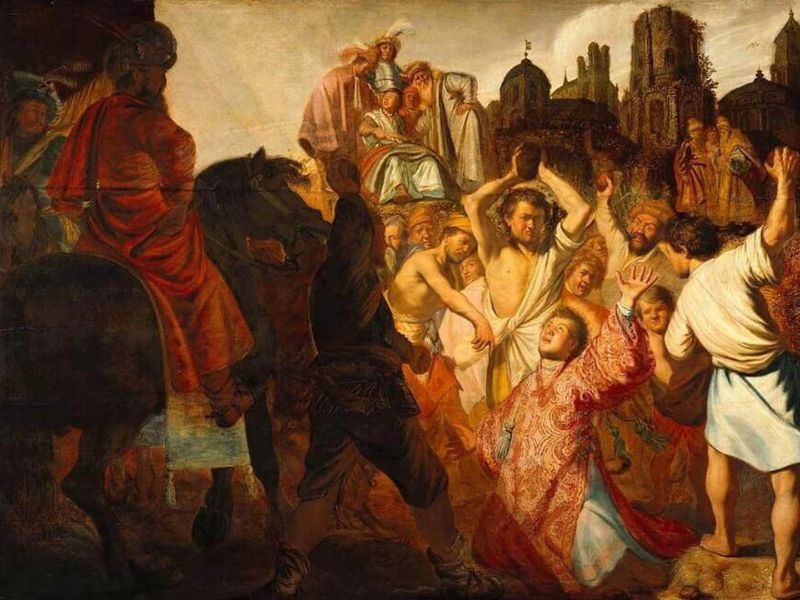
Stephen: The First Christian Martyr
The story does not wait long to move from theology to reality. It happens almost immediately. His name was Stephen. He was not one of the Twelve Apostles.
He was not a famous leader. He was a deacon in the early church, chosen to care for practical needs, to serve faithfully among the people of God. But Scripture tells us something more about him. He was “full of faith and of the Holy Spirit” (Acts 6:5) and “full of God’s grace and power” (Acts 6:8).
Stephen did not seek confrontation, but his life and his message could not be ignored. As he proclaimed Christ, opposition rose quickly. False accusations were brought against him. He was dragged before the religious authorities. And there, standing before those who held power over his life, Stephen did something remarkable.
He bore witness. He retold the story of Israel and of God’s faithfulness, purposes, and promises. Then he spoke the truth they did not want to hear: “You always resist the Holy Spirit!” (Acts 7:51). The room shifted. What began as a hearing became rage. The men listening to him were furious. And then, in that moment, Stephen saw something no one else could see. “Look,” he said, “I see heaven open and the Son of Man standing at the right hand of God.” (Acts 7:56) Heaven was not silent. Heaven was watching. And Christ himself was standing.
A Death That Became a Beginning
They rushed at him. They dragged him out of the city. And they began to stone him. This is where theology and reality collide. This is where the words of Jesus, “take up your cross,” become flesh. As the stones fell, Stephen did not curse. He did not retaliate. He prayed. “Lord Jesus, receive my spirit.” (Acts 7:59) And then, in one of the most Christ-like moments in all of Scripture, he cried out, “Lord, do not hold this sin against them.” (Acts 7:60) And with that, he died.
The Death That Ignited the Mission
But Stephen’s death was not the end. It was a beginning. Immediately after his martyrdom, Scripture tells us, “On that day a great persecution broke out against the church in Jerusalem … and all except the apostles were scattered.” (Acts 8:1) What seemed like defeat became movement. What seemed like suppression became a multiplication. The believers were scattered. And wherever they went … They preached Christ. The gospel moved beyond Jerusalem. The mission expanded. And standing there, watching Stephen die, was a young man named Saul. The one who would later become Paul. The apostle to the nations. The witness continues.
Their Blood Still Speaks
Stephen’s life and death reveal something we must not miss. The witness of the faithful does not end in silence. It echoes. It multiplies. It ignites. His blood, like Abel’s, speaks. Not only before God … but into history. The question is no longer whether the martyrs have a voice. The question is, “What is their witness saying to us?”
The Question Before the Church
Stephen was not extraordinary because of his position. He was extraordinary because of his faithfulness. He believed what Jesus said. He lived it. And when the moment came, he stood. As we enter the history of the church, we will encounter many more like him. Men and women who stood when it would have been easier to remain silent. Who remained faithful when it would have been safer to compromise. Who followed Christ not only in word, but in life, and in death. Their stories are not given to us so we might admire them. They are given so that we might examine ourselves. The witness continues. Are we still listening?
Are We Willing to Pay the Cost?
Stephen’s story confronts us with a question that reaches into our own lives. Are we living as witnesses to Jesus? Not only when it is easy, but when it is costly? Do our lives reflect a faith that is visible, courageous, and anchored in Christ? Or have we shaped a version of Christianity that avoids risk, avoids tension, and avoids the cross?
Stephen did not seek death. But he did not avoid faithfulness. And because of that, his life and his death became part of a story that is still unfolding. The cloud of witnesses is growing. Their voices are not silent. Their testimony still speaks. And as we step into the history of the church, we must decide: Will we remain observers of this story … or will we become participants in it?
Click here to read more from the series.
To read more news stories, visit the ICC Newsroom. For interviews, please email us. To support ICC’s work around the world, please give to our Where Most Needed Fund.